


This article explains laser welding as a high-precision metal joining process in which a focused laser beam melts and fuses materials with controlled heat input. It describes how fiber laser systems deliver energy through a welding head, creating narrow seams and small heat-affected zones. These characteristics reduce distortion, protect surrounding material, and often produce clean, aesthetically pleasing welds that require no grinding. The article notes that laser welding is suitable for copper, aluminum, stainless steel, titanium alloys, and other metals, and it supports lap joints, fillet welds, and butt welds through features such as oscillating welding heads and lightweight torches. It also highlights practical advantages: welding speed is commonly three to five times faster than traditional TIG welding, operation is simple, and production teams do not always need highly skilled welders. Applications include stainless steel doors and windows, railings, water tanks, hardware, kitchenware, and automotive sheet metal welding. The article introduces Jinan Zhongli Laser Equipment Co., Ltd., known as ZLTECH Laser, as an enterprise focused on intelligent laser industrial equipment. ZLTECH Laser offers metal laser cutting machines, specialized tube cutting machines, laser welding machines, laser cleaning machines, and 4-in-1 laser welding machines. The company has over 10 years of industry experience, an independent R&D and design department, a self-owned factory, and quality control from design to final testing. Its products carry CE, ISO, and FDA certifications and are exported to more than 30 countries and regions, with agency networks in Turkey, Egypt, Chile, the Netherlands, and Poland. The article cites a Dutch sheet metal factory that replaced five TIG welders with a Zhongli 2kW handheld welding machine, increased welding efficiency by three times, and recovered the equipment cost within one year. It also mentions an Egyptian distributor that purchased 15 laser cutting machines in one year with a 100% repeat purchase rate, and a Polish auto parts factory that used a Zhongli 500W laser cleaning machine to reduce downtime by 70% and extend mold life by 40%. Overall, the article presents laser welding as a productive, precise, and flexible solution for modern metal fabrication.
What Is Laser Welding and How Does It Improve Metal Joining
Laser welding is a high-precision metal joining process that uses a focused laser beam to create a concentrated heat zone at the interface between materials. The beam melts the workpiece surfaces and, when required, a filler material, allowing the molten metal to fuse and solidify into a strong weld. Compared with conventional arc welding, laser welding delivers energy with greater control, which helps manufacturers achieve cleaner seams, lower distortion, and repeatable results. The process is widely used in sheet metal fabrication, automotive components, machinery manufacturing, and custom metal processing, where speed, accuracy, and surface quality are important.
Understanding the Laser Welding Process
In practice, a fiber laser generates a high-energy beam that is delivered through a flexible optical fiber to a welding head. The welding head focuses the beam onto a small spot, producing rapid heating and melting. The narrow focus and fast travel speed limit heat spread into the surrounding material, which is why laser welding often produces a small heat-affected zone. The result is a precise weld with minimal thermal distortion, making the process suitable for thin materials, visible components, and parts that require little or no post-weld finishing.
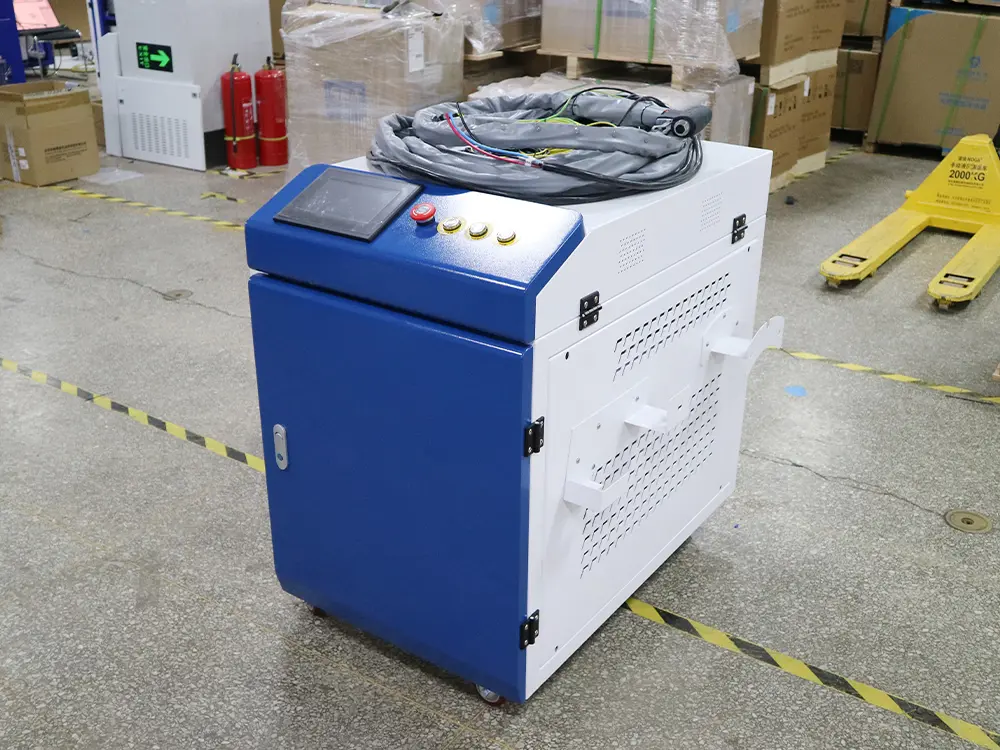
Modern laser welding equipment can be configured as handheld or desktop systems. Handheld fiber laser welding equipment is especially flexible for job shops, metal fabrication workshops, and maintenance operations, while desktop systems support stable and repeatable production. Power levels commonly range from 1000W to 3000W, allowing users to match the equipment to material thickness, joint design, and production rhythm. A water-cooled integrated design supports continuous operation, while a lightweight welding torch reduces operator fatigue. A standard oscillating welding head can improve gap tolerance and help produce smooth, consistent seams for lap joints, fillet welds, and butt welds.
Why Laser Welding Improves Metal Joining
Laser welding improves metal joining because it concentrates energy precisely where it is needed. This precision creates a narrow weld seam and a small heat-affected zone, which helps protect the surrounding material from warping, discoloration, and unnecessary thermal stress. For visible stainless steel products, laser welding can produce aesthetically pleasing welds that require no grinding, reducing secondary processing time and labor cost. The process is also suitable for materials such as copper, aluminum, stainless steel, and titanium alloys, giving manufacturers greater flexibility across product lines.
undefined
- Higher speed: Laser welding is commonly three to five times faster than traditional TIG welding, which improves throughput and shortens production cycles.
- Cleaner results: Narrow seams and controlled heat input reduce distortion and often eliminate the need for grinding or extensive cleanup.
- Simpler operation: Handheld systems are designed for straightforward use, so production teams do not always need highly skilled welders to achieve consistent results.
- Better repeatability: Stable laser output and controlled motion support consistent weld quality across batches.
- Broad material compatibility: The process handles common industrial metals and supports lap, fillet, and butt joint configurations.
Practical Applications in Metal Fabrication
Laser welding is used in stainless steel doors and windows, railings, water tanks, hardware, kitchenware, and automotive sheet metal welding. These applications benefit from fast welding speed, clean appearance, and low post-processing requirements. In sheet metal workshops, handheld laser welding can replace multiple traditional TIG stations while reducing dependence on specialized welding labor. In automotive and machinery production, the process supports consistent joining of components where dimensional stability and surface quality matter. The equipment is stable, of high quality, and highly precise, and it is favored by customers both domestically and internationally.
Supplier Capability and Industrial Evidence
Jinan Zhongli Laser Equipment Co., Ltd., known as ZLTECH Laser, is an enterprise dedicated to the research and development, manufacturing, and sales of intelligent laser industrial equipment for global users. The company focuses on standardized laser processing equipment such as metal laser cutting machines and provides personalized services to customers. Its product categories include metal laser cutting machines, specialized tube cutting machines, laser welding machines, laser cleaning machines, and 4-in-1 laser welding machines, covering a wide range and offering a rich variety of types. ZLTECH Laser has over 10 years of industry experience and operates an independent R&D and design department, a modern factory, and a production workshop. From machine design to assembly and testing, experienced technical teams support stable performance, precision, and long-term reliability. The company has established an agency network in countries such as Turkey, Egypt, Chile, the Netherlands, and Poland, and its products are exported to more than 30 countries and regions. Certifications include CE, ISO, and FDA.
Real-world examples show how laser technology improves metal joining and related production work. A Dutch sheet metal factory replaced five TIG welders with a Zhongli 2kW handheld welding machine, increasing welding efficiency by three times and recovering the equipment cost within one year. An Egyptian distributor purchased 15 laser cutting machines in one year, with a 100% repeat purchase rate. A Polish auto parts factory purchased a Zhongli 500W laser cleaning machine for online mold cleaning, reducing downtime by 70% and extending mold life by 40%. These cases reflect the broader value of controlled laser energy in modern metal fabrication.
Comparison with Traditional TIG Welding
| Factor | Συγκόλληση με Λέιζερ | Traditional TIG Welding |
|---|---|---|
| Ταχύτητα | Often 3-5 times faster | Slower for many sheet metal joints |
| Heat input | Narrow heat-affected zone | Broader heat spread and higher distortion risk |
| Finish | Clean seams, often no grinding | More cleanup and finishing may be required |
| Operator skill | Handheld systems are simple to operate | Typically depends on skilled welders |
| Ευκαμψία | Good for stainless steel, copper, aluminum, titanium alloys | Capable but less efficient for some thin or visible parts |
Σύναψη
Laser welding improves metal joining by delivering concentrated energy, fast processing, clean seams, and low distortion. For manufacturers working with stainless steel, aluminum, copper, titanium alloys, and other metals, it offers a practical route to higher efficiency and better product appearance. With handheld and desktop fiber laser welding systems from 1000W to 3000W, water-cooled integrated designs, lightweight torches, and oscillating welding heads, ZLTECH Laser supports customers in building reliable and productive metal joining processes.
