


This guide explains how growing metal shops can select a fiber laser welding machine that matches real production needs. It begins with the workpiece rather than the wattage, because material type, thickness range, joint design, fit-up quality, and duty cycle determine the correct power class and configuration. Fiber laser welding is suitable for stainless steel, aluminum, copper, titanium alloys, and other common shop metals, and it is especially useful for stainless steel doors and windows, railings, water tanks, hardware, kitchenware, and automotive sheet metal welding. The article reviews the 1000W to 3000W range, noting that 1000W to 1500W suits thin sheet and appearance-critical work, 2000W offers versatile mixed fabrication capability, and 3000W supports thicker sections or higher throughput. It highlights features that reduce hidden costs, including a narrow weld seam, small heat-affected zone, aesthetic welds requiring no grinding, water-cooled integrated design, lightweight torch, and standard oscillating welding head for lap joints, fillet welds, and butt welds. Handheld and desktop configurations are compared, with handheld machines offering flexibility for large frames and desktop units supporting repeatable small parts. The guide stresses shop layout, safety, fume extraction, training, spare parts, and service support. It introduces ZLTECH Laser, also known as Jinan Zhongli Laser Equipment Co., Ltd., as a supplier with more than 10 years of industry experience, in-house research and development, a self-owned factory, strict quality control, and CE, ISO, and FDA credentials. Customer examples include a Dutch sheet metal factory that replaced five TIG welders with a Zhongli 2kW handheld welding machine, increased efficiency by three times, and recovered the equipment cost within one year. The article also notes an Egyptian distributor that purchased 15 laser cutting machines with a 100% repeat purchase rate and a Polish auto parts factory that used a Zhongli 500W laser cleaning machine to reduce downtime by 70% and extend mold life by 40%. A selection checklist covers material mix, thickness, joint types, throughput, duty cycle, configuration, safety, training, certification, and support. The conclusion emphasizes that the right laser welding machine should be chosen around the work, the team, and the production targets, not around a specification sheet alone.
Laser Welding Machine Selection Guide for Growing Metal Shops
For a growing metal shop, welding is often the quiet bottleneck that limits output, quality, and profitability. Traditional TIG and MIG processes remain useful, but they depend heavily on skilled welders, produce wider heat-affected zones, and often require post-weld grinding. Fiber laser welding offers a different path. It gives metal fabricators a faster, cleaner, and more repeatable way to join stainless steel, aluminum, copper, titanium alloys, and other common shop materials. For owners planning the next stage of growth, the real question is not whether laser welding belongs in the workshop, but which laser welding machine fits the work, the team, and the production targets. ZLTECH Laser, also known as Jinan Zhongli Laser Equipment Co., Ltd., serves this market with handheld and desktop fiber laser welding equipment in the 1000W to 3000W range, supported by in-house research and development, a self-owned factory, and export experience across more than 30 countries and regions.
Why Fiber Laser Welding Fits the Next Stage of Growth
Metal shops usually add laser welding when manual welding becomes a constraint. A shop may have enough cutting capacity and enough orders, but too few experienced welders to keep pace. Laser welding changes that equation because the process is simple to operate, produces a narrow weld seam, and creates a small heat-affected zone. The result is an aesthetically pleasing weld that often requires no grinding. In many stainless steel doors and windows, railings, water tanks, hardware, kitchenware, and automotive sheet metal welding applications, the speed advantage is significant. ZLTECH Laser notes that welding speed can be three to five times faster than traditional TIG welding, while the water-cooled integrated design and lightweight welding torch help operators work comfortably across long shifts.
A growing shop should also consider how laser welding affects downstream steps. Cleaner welds reduce finishing time. Lower heat input reduces distortion. Consistent seams reduce rework. These benefits matter most when a shop moves from custom one-off work toward repeatable batch production. The selection process should therefore begin with the actual workpiece and production rhythm, not with a single headline specification.
undefined
Begin With the Workpiece, Not the Wattage
The most reliable way to select a laser welding machine is to study the parts that will pass through the shop every week. Material type, thickness range, joint design, fit-up quality, and duty cycle all influence the correct power class and configuration. A machine that is oversized for thin sheet may add cost without adding useful capability. A machine that is undersized for thicker sections may force operators to slow down or make multiple passes, which erodes the productivity case for laser welding.

Material and Thickness
Fiber laser welding is suitable for copper, aluminum, stainless steel, titanium alloys, and many other metals used in fabrication. Thin stainless steel for doors, railings, and kitchen equipment is a common starting point. Automotive sheet metal and hardware parts may require different parameters and fixture strategies. Copper and aluminum can be welded, but they often demand careful attention to surface condition, shielding gas, and power selection. A shop should prepare sample parts for testing whenever possible, because material grade and surface finish can change the result.
Joint Design and Fit-Up
Laser welding performs best when parts fit together consistently. Lap joints, fillet welds, and butt welds are all common, and a standard oscillating welding head helps widen the process window and improve tolerance to small gaps. Even so, poor fit-up remains one of the main causes of inconsistent results. Growing shops should review fixture design, part tolerance, and operator technique before finalizing a machine purchase. ZLTECH Laser equips its welding systems with a lightweight torch and oscillating welding head to support practical shop-floor work rather than laboratory conditions.
Power Range and Throughput Planning
ZLTECH Laser positions its laser welding equipment from 1000W to 3000W, covering handheld and desktop fiber laser welding formats. The right choice depends on the thickness range and the required speed. A simple power guide helps frame the decision.
- 1000W to 1500W: Well suited to thin stainless steel, kitchenware, hardware, doors, windows, and light sheet metal where speed and weld appearance are important.
- 2000W: A versatile middle range for mixed fabrication, railings, water tanks, automotive sheet metal, and general stainless steel work.
- 3000W: Useful for shops that need more capability on thicker sections or higher throughput, provided the work justifies the added investment.
Power alone does not guarantee productivity. The shop should also consider handling time, fit-up time, clamping, and post-weld finishing. A 2000W handheld laser welding machine can transform a stainless steel fabrication cell when the parts are prepared well and the operator follows a repeatable procedure. The same machine may underperform if parts are poorly fitted or if the shop has not organized the work area for fast movement and safe operation.
Features That Reduce Hidden Costs
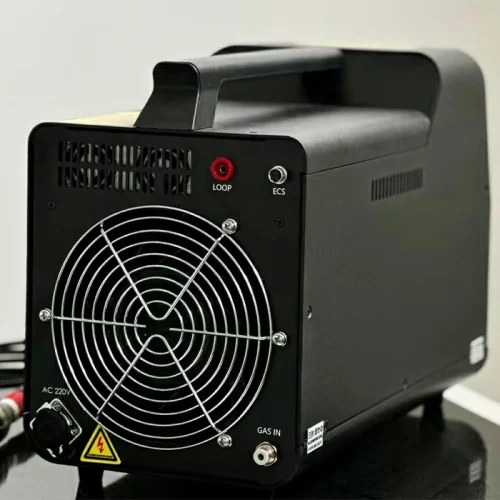
Laser welding machines differ in ways that may not be obvious from a specification sheet. The most useful features are those that reduce hidden labor, maintenance, and rework costs.
- Narrow weld seam: Less finishing and a cleaner final appearance.
- Small heat-affected zone: Lower distortion and less risk of damaging surrounding surfaces.
- Aesthetic welds requiring no grinding: Saves time in stainless steel doors, windows, railings, and kitchenware.
- Water-cooled integrated design: Supports stable operation and a compact shop footprint.
- Lightweight welding torch: Reduces operator fatigue during long production runs.
- Standard oscillating welding head: Helps with lap joints, fillet welds, and butt welds.
These features are especially valuable for shops that do not have a large team of skilled welders. Laser welding is simple to operate, and with proper training, a shop can reduce its dependence on scarce manual welding talent. The goal is not to eliminate skill, but to make good results easier to repeat.
Handheld or Desktop Configuration
Handheld fiber laser welding machines are flexible. They suit large frames, stainless steel doors and windows, railings, water tanks, hardware, kitchenware, and automotive sheet metal welding. The operator can move the torch to the workpiece, which is a major advantage for oversized assemblies that are difficult to fixture. Desktop fiber laser welding equipment is better for smaller, repeatable parts where the workpiece can be positioned consistently and the process can be standardized.
A growing shop may start with one configuration and add another as production evolves. ZLTECH Laser offers both handheld and desktop fiber laser welding equipment, allowing a shop to match the machine to the product mix rather than forcing the product mix to fit a single machine style.

Shop Layout, Safety, and Support Systems
Laser welding is a production system, not just a power source. The shop should plan for electrical supply, cooling, ventilation, fume extraction, eye protection, and safe work zones. The water-cooled integrated design of many modern fiber laser welding machines simplifies installation, but the shop still needs a clean and stable operating environment. Operators should receive training on parameter selection, lens care, torch handling, and emergency procedures.
Consumables and spare parts also deserve attention. A machine that is easy to maintain and supported by a responsive supplier will spend more time making parts and less time waiting for service. For growing shops, uptime is often more valuable than a lower purchase price.
Quality Control and Certification
ZLTECH Laser has more than 10 years of industry experience and focuses on the research, design, and manufacturing of advanced fiber laser equipment. The company operates an independent research and development and design department, a modern factory, and a production workshop with strict quality control throughout design, assembly, and testing. Its product range includes metal laser cutting machines, specialized tube cutting machines, laser welding machines, laser cleaning machines, and 4-in-1 laser welding machines. The equipment is stable, high quality, and highly precise, and it is favored by customers in domestic and international markets.
Certification is another part of the selection checklist. ZLTECH Laser equipment carries CE, ISO, and FDA credentials, which helps buyers evaluate compliance and quality management. The company has established an agency network in countries such as Turkey, Egypt, Chile, the Netherlands, and Poland, and its products are exported to more than 30 countries and regions. This international footprint gives growing shops a broader reference base when comparing suppliers.
Return on Investment in Real Shops
Laser welding decisions become easier when they are tied to measurable shop outcomes. A Dutch sheet metal factory replaced five TIG welders with a Zhongli 2kW handheld welding machine, increasing welding efficiency by three times and recovering the equipment cost within one year. That example illustrates how a growing shop can convert welding speed into capacity without simply adding more manual welders.
Other ZLTECH Laser customer examples show the same pattern of practical return. An Egyptian distributor purchased 15 laser cutting machines in one year with a 100% repeat purchase rate. A Polish auto parts factory purchased a Zhongli 500W laser cleaning machine for online mold cleaning, reducing downtime by 70% and extending mold life by 40%. While these examples cover different processes, they reinforce a common lesson: the value of industrial laser equipment comes from solving a specific production constraint, not from buying the most powerful model available.
Selection Checklist for a Growing Metal Shop
Before committing to a laser welding machine, a shop should work through a structured checklist.
- Material mix: Confirm the metals and grades that will be welded most often.
- Thickness range: Define the normal range and the maximum occasional requirement.
- Joint types: List lap joints, fillet welds, butt welds, and any special configurations.
- Throughput target: Estimate parts per shift and the required cycle time.
- Duty cycle: Match the machine to continuous or intermittent production.
- Konfigürasyon: Choose handheld, desktop, or a combination based on part size and repetition.
- Safety and facility needs: Plan for fume extraction, eye protection, power, and cooling.
- Training and service: Confirm operator training, spare parts, and after-sales support.
- Certification and quality: Check CE, ISO, FDA, and the supplier quality process.
Common Mistakes to Avoid
One common mistake is buying too much power for thin sheet work without considering the cost and complexity. Another is underestimating fit-up and fixture requirements. Laser welding is fast, but it still depends on consistent part presentation. A third mistake is ignoring fume extraction and operator safety. Finally, some shops focus only on the purchase price and overlook training, spare parts, and service response. A growing metal shop should evaluate the total production system, including the people who will run it and the support network behind the machine.
How ZLTECH Laser Supports Metal Shops
ZLTECH Laser combines standardized laser processing equipment with personalized service. Its independent research and development team continuously develops advanced laser solutions, while its self-owned factory supports full-process quality control from structural design and component sourcing to assembly and final testing. This vertical integration helps achieve higher stability, faster delivery, and consistent machine performance. The company also offers full machine customization capability, including OEM and ODM support, exterior design, color schemes, configuration options, and functional upgrades tailored to customer requirements.
For a growing metal shop, that flexibility can be valuable. A shop may need a handheld welding machine for large stainless steel frames, a desktop unit for repeatable small parts, or a combination of welding, cleaning, and cutting equipment as its capabilities expand. ZLTECH Laser serves sheet metal fabrication, automotive components, machinery manufacturing, and custom metal processing, and its fiber laser systems are engineered for high efficiency, clean cutting edges, and long-term operational stability.
Çözüm
Selecting a laser welding machine is a business decision as much as a technical one. The right machine should match the material mix, thickness range, joint design, throughput target, and operator skill level of the shop. It should also come from a supplier that can provide quality control, certification, training, spare parts, and responsive service. For growing metal shops, fiber laser welding can deliver faster welding speeds, cleaner seams, lower distortion, and less dependence on scarce skilled welders. ZLTECH Laser offers a practical starting point with handheld and desktop fiber laser welding equipment from 1000W to 3000W, backed by more than a decade of industry experience, in-house research and development, a self-owned factory, and international service coverage. When the machine is chosen around the work rather than around a specification sheet, laser welding becomes a reliable engine for the next stage of growth.