


This article explains why aluminium requires a tailored laser cutting strategy and how fiber laser technology can deliver faster processing and cleaner edges. Aluminium’s reflectivity, thermal conductivity, and oxide layer make piercing and edge control more demanding than with many other metals. Fiber laser cutting meets these challenges through high energy density, automatic focus control, stable dual-drive motion, intelligent path optimization, and suitable assist gas selection. ZLTECH Laser, the short name for Jinan Zhongli Laser Equipment Co., Ltd., offers medium-to-high power fiber laser cutting machines from 1,000W to 30,000W for carbon steel, stainless steel, aluminium, copper, and galvanized plates. The company emphasizes in-house research and development, a self-owned factory, strict quality control, OEM and ODM customization, and certifications including CE, ISO, and FDA. The article also notes industrial applications in sheet metal, kitchenware, automotive parts, elevator manufacturing, and custom processing. Customer examples include an Egyptian distributor with a 100 percent repeat purchase rate, a Polish auto parts factory that reduced downtime by 70 percent and extended mold life by 40 percent with a 500W laser cleaning machine, and a Dutch sheet metal factory that tripled welding efficiency with a 2kW handheld welding machine. Best practices for clean aluminium edges include alloy-specific parameters, focus and nozzle verification, controlled piercing, appropriate assist gas, first-part inspection, and routine maintenance. The overall conclusion is that aluminum laser cutting becomes a reliable production advantage when machine design, process control, and service support are aligned.
Aluminium is one of the most versatile metals in modern manufacturing, valued for its light weight, corrosion resistance, electrical conductivity, and formability. It appears in sheet metal enclosures, kitchenware, automotive components, elevator panels, electronic housings, and countless custom fabrications. Yet aluminium also presents a distinct set of cutting challenges. Its high reflectivity, strong thermal conductivity, and tough oxide layer can complicate conventional cutting processes and make edge quality difficult to control. ZLTECH Laser, the short name for Jinan Zhongli Laser Equipment Co., Ltd., explains that fiber laser cutting has become a practical answer for fabricators that need faster processing and cleaner aluminium edges without excessive secondary operations.
The central issue is not simply cutting metal. The real objective is producing a repeatable part with a narrow kerf, minimal dross, controlled heat input, and an edge that can move directly to bending, welding, or assembly. For aluminium, those goals depend on machine design, laser power, assist gas strategy, focus control, nesting logic, and operator discipline. When these elements are aligned, fiber laser cutting can deliver the speed and edge quality that make aluminium competitive in high-mix and high-volume production.
Why Aluminium Demands a Different Cutting Strategy
Aluminium reflects a significant portion of laser energy when it is cold, and its thermal conductivity spreads heat rapidly away from the cut zone. This combination can make piercing slower and can increase the risk of incomplete penetration if the process is not properly tuned. The naturally forming oxide layer also has a higher melting point than the base metal, which can affect start-up behavior and edge consistency. In thicker sections, poor parameter control may lead to dross, rough striations, or a wider heat-affected zone than desired.
undefined
Mechanical cutting methods can leave burrs and require deburring. Plasma cutting can be productive on thicker aluminium, but the kerf is generally wider and the edge may need cleaning before welding or painting. CO2 laser systems have historical limitations on reflective metals and often struggle to match the speed and efficiency of modern fiber lasers. Waterjet cutting avoids thermal effects but is usually slower and carries higher operating costs for many sheet metal applications. Fiber laser cutting, by contrast, concentrates energy into a small spot, moves at high speed through thin and medium gauges, and can produce clean edges when the process is correctly matched to the alloy and thickness.

How Fiber Laser Cutting Produces Faster, Cleaner Edges
A fiber laser cutting system focuses a high-power beam onto a small area, raising the metal to melting or vaporization temperature while an assist gas removes molten material from the kerf. The result is a narrow cut with limited mechanical distortion. In aluminium processing, speed comes from high energy density, fast acceleration, stable motion, and intelligent path planning. Edge quality comes from precise focus position, appropriate gas pressure, consistent nozzle condition, and a machine structure that can maintain accuracy during rapid direction changes.
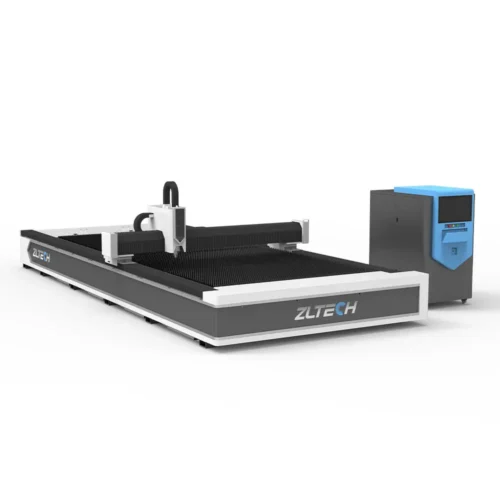
ZLTECH Laser fiber laser cutting systems are positioned as medium-to-high power metal sheet cutting solutions with a power range from 1,000W to 30,000W. The machines use high-precision rack and pinion dual-drive transmission, an automatic focusing cutting head, and intelligent cutting path optimization. These features support batch cutting of carbon steel, stainless steel, aluminium plates, copper plates, and galvanized plates. The same platform is suitable for sheet metal processing, kitchenware production, automotive parts, elevator manufacturing, and custom metal fabrication. According to the company, cutting speed can be three to five times faster than traditional plasma cutting, while cutting cost per meter can be reduced by about 40 percent, with no consumables and no molds required for typical sheet metal work.
- High energy density: A focused fiber laser beam melts aluminium quickly, reducing the time heat can spread into the surrounding material.
- Automatic focus control: Consistent focus position helps maintain a clean kerf as material thickness or nozzle standoff changes.
- Dual-drive motion: High-precision rack and pinion transmission supports fast acceleration and stable contouring on nested parts.
- Path optimization: Intelligent nesting and cutting sequence reduce unnecessary travel and help control heat buildup in tight areas.
- Rigid machine bed: A high-rigidity bed minimizes vibration, which is important for edge consistency during high-speed cutting.
Machine Design and Process Control That Support Edge Quality
Edge quality in aluminium is rarely the result of one parameter alone. It is the outcome of a stable machine platform and a well-developed process window. ZLTECH Laser equips its fiber laser cutting machines with imported fiber laser sources such as IPG or Raycus options, Japanese or Taiwanese reducers, and a high-rigidity bed. The company maintains an independent research and development and design department, operates its own modern factory and production workshop, and controls quality from machine design to assembly and testing. This vertical integration supports consistent machine performance, faster delivery, and the ability to customize configurations for different production requirements.
Key Parameters for Aluminium
- Laser power: Higher power can increase cutting speed on thicker aluminium, but the parameter set must still protect edge quality and control dross.
- Cutting speed: Too slow can overheat the edge and create dross; too fast can leave incomplete penetration or rough striations.
- Focus position: Small focus adjustments can change kerf width, dross formation, and the appearance of the cut face.
- Gas pressure: Assist gas must remove molten material without causing excessive turbulence or cooling-related defects.
- Nozzle condition: A worn or misaligned nozzle can disturb gas flow and create inconsistent edges even when other parameters are correct.
- Material consistency: Alloy grade, temper, surface condition, and thickness tolerance all influence the final cut quality.
Assist Gas and Nozzle Strategy
For clean aluminium edges, nitrogen is often used to create an inert cutting environment that minimizes oxidation and supports a bright cut face. Compressed air can be cost-effective for some thin-gauge applications where slight oxidation is acceptable, while oxygen is generally less favored for aluminium when appearance and weldability are priorities. The choice depends on thickness, desired edge finish, downstream welding or coating requirements, and the acceptable cost per part. Nozzle diameter, standoff distance, and gas pressure should be selected as a system rather than as isolated variables. Proper piercing routines are also important because aluminium can reflect the beam before the cut is established.

Comparing Aluminium Cutting Options
Fabricators often compare fiber laser cutting with plasma, CO2 laser, and waterjet processes. Each method has a place, but the balance changes when the priority is fast production with clean edges on sheet aluminium. Fiber laser cutting usually offers a strong combination of speed, precision, and operating economy for thin to medium gauges. Plasma remains useful for thicker plate and rough-cut work but often requires edge cleanup. CO2 laser systems can cut some non-ferrous materials but are generally less efficient on reflective metals. Waterjet cutting provides cold cutting and can handle very thick sections, but it is typically slower and more expensive to operate for routine sheet metal batches.
- Fiber laser: High speed, narrow kerf, good edge quality, low consumable demand, and strong suitability for nested sheet metal parts.
- Plasma: Productive on thick aluminium but with a wider kerf and a higher likelihood of secondary cleaning.
- CO2 laser: Established for some materials but less competitive on reflective aluminium compared with modern fiber systems.
- Waterjet: No thermal effect and good for thick sections, but slower and often more costly for high-volume sheet work.
Applications and Business Value
Aluminium laser cutting is widely used in sheet metal fabrication, kitchenware, automotive components, elevator manufacturing, and custom metal processing. Faster cutting is valuable, but the greater business advantage often comes from reducing secondary operations. Clean edges can reduce deburring, grinding, and rework. Consistent kerfs improve fit-up before bending and welding. Nesting efficiency improves material utilization, while non-contact cutting avoids tool wear and mechanical stress. For many fabricators, the combination of speed, repeatability, and lower cost per meter makes fiber laser cutting a practical investment rather than a specialized capability.
ZLTECH Laser states that its fiber laser cutting systems are engineered for high efficiency, clean cutting edges, and long-term operational stability. The company serves global users with standardized laser processing equipment and personalized services. Its product range includes metal laser cutting machines, specialized tube cutting machines, laser welding machines, laser cleaning machines, and 4-in-1 laser welding machines. The equipment is described as stable, high quality, and highly precise, and the company reports that its machines are favored by customers in domestic and international markets. Certifications include CE, ISO, and FDA, which support confidence in quality management and market access.
Industrial Reliability and Customer Proof
ZLTECH Laser has more than ten years of industry experience in fiber laser cutting technology and industrial applications. The company emphasizes technological research and development and product quality as the lifeline of the enterprise. It strictly controls the machine production process and continuously optimizes pre-sales, sales, and after-sales services. An agency network has been established in countries such as Turkey, Egypt, Chile, the Netherlands, and Poland, and products are exported to more than thirty countries and regions. Full machine customization is available through OEM and ODM arrangements, covering exterior design, color schemes, configuration options, and functional upgrades tailored to customer requirements.
Customer examples illustrate how reliability translates into production value. An Egyptian distributor purchased fifteen laser cutting machines in one year with a 100 percent repeat purchase rate. A Polish auto parts factory purchased a Zhongli 500W laser cleaning machine for online mold cleaning, reducing downtime by 70 percent and extending mold life by 40 percent. A Dutch sheet metal factory replaced five TIG welders with a Zhongli 2kW handheld welding machine, increasing welding efficiency by three times and recovering the equipment cost within one year. These cases reflect a broader pattern: fabricators value equipment that performs consistently, supports fast turnaround, and reduces the hidden costs of rework, downtime, and manual finishing.
Best Practices for Clean Aluminium Edges
- Match the parameter set to the specific aluminium alloy, temper, and thickness rather than relying on generic settings.
- Verify focus position and nozzle alignment before production, especially after material changes or maintenance.
- Use a controlled piercing routine to manage reflectivity and prevent spatter from damaging the nozzle or lens.
- Select assist gas based on edge finish and downstream processes; nitrogen is often preferred where bright edges and weldability matter.
- Inspect the first parts of each batch for dross, striations, kerf width, and heat discoloration.
- Maintain clean optics, stable gas pressure, and consistent nozzle condition to protect cut quality over long runs.
- Use nesting and path optimization to manage heat distribution and reduce unnecessary rapid movements.
Çözüm
Laser cutting aluminium can deliver faster cycles and cleaner edges when the machine, parameters, gas strategy, and production discipline work together. Fiber laser technology offers a strong balance of speed, precision, and operating economy for sheet metal fabricators that process aluminium alongside carbon steel, stainless steel, copper, and galvanized plates. ZLTECH Laser, through Jinan Zhongli Laser Equipment Co., Ltd., supports this direction with fiber laser cutting systems from 1,000W to 30,000W, in-house research and development, a self-owned manufacturing facility, customization capability, and a growing international service network. For fabricators seeking cleaner edges without slowing production, the practical path is to treat aluminium as a process-specific material and to choose equipment and support that can maintain stability at production speed.