


This article presents a manufacturer checklist for selecting a laser plastic marking machine that delivers clean marking on plastic components. Clean marking is defined as sharp contrast, precise edges, no charring or melting, controlled debris, stable code readability, and repeatable results across production batches. The checklist begins with application engineering and material validation, because plastics vary widely in absorption, heat sensitivity, color, and additive content. Buyers should require sample testing on the actual material grade, documented parameters, microscope or high-resolution images, and scan verification for codes. The next evaluation areas are laser source and wavelength selection, optics and beam delivery, motion and software control, thermal parameter windows, fume extraction, fixturing, sample validation, quality control, compliance, service, customization, and total cost of ownership.
The article emphasizes that a clean mark is a process result, not a single machine feature. The manufacturer should explain how it controls energy delivery, focus, pulse frequency, heat accumulation, and debris removal. It should provide a parameter window, a written acceptance standard, and a pre-shipment acceptance test. Red flags include suppliers that promise clean marking without material samples, omit extraction requirements, cannot document test results, or offer no local service and spare parts plan. The article also places these requirements in a broader industrial laser context by referencing Jinan Zhongli Laser Equipment Co., Ltd., known as ZLTECH Laser. The company reports more than 10 years of experience, in-house research and development, a self-owned factory, OEM and ODM customization, and applications in metal cutting, welding, and cleaning. Its product range includes metal laser cutting machines, specialized tube cutting machines, laser welding machines, laser cleaning machines, and 4-in-1 laser welding machines. The article notes ZLTECH Laser s agency network in Turkey, Egypt, Chile, the Netherlands, and Poland, exports to more than 30 countries, and customer examples involving an Egyptian distributor, a Dutch sheet metal factory, and a Polish auto parts factory. These examples reinforce the main message: buyers should evaluate evidence, application engineering, quality systems, and long-term support before purchasing a laser plastic marking system. A final audit checklist is provided to confirm the tested configuration, fixture, extraction, training, compliance documents, spare parts, and warranty terms before order placement.
Clean marking on plastic parts is not a cosmetic detail. It is a functional requirement that affects traceability, brand presentation, regulatory compliance, assembly accuracy, and customer confidence. A laser plastic marking machine manufacturer that can deliver clean marks consistently must be evaluated with more discipline than a simple price comparison. The checklist in this article is designed for procurement teams, manufacturing engineers, quality managers, and product designers who need to select a supplier capable of producing crisp, durable, and repeatable marks on plastics without charring, melting, ghosting, or uncontrolled debris.
The subject is especially important because plastics behave very differently from metals. A parameter set that produces a clean mark on one polymer may cause foaming, discoloration, or micro-cracking on another. The manufacturer must therefore demonstrate application knowledge, material testing discipline, optical control, software stability, thermal management, fume extraction, fixturing competence, and after-sales support. The following checklist organizes those requirements into practical evaluation areas and highlights the evidence a buyer should request before placing an order.
undefined
Why Clean Marking Deserves a Manufacturer Checklist
Plastic components appear in electronics housings, medical devices, automotive interior parts, packaging, appliances, safety equipment, connectors, switches, and consumer goods. In many of these applications, the mark carries a serial number, a date code, a safety warning, a logo, a QR code, or a regulatory symbol. If the mark is fuzzy, the code may fail to scan. If the mark is burned, the part may fail a visual inspection. If the mark generates loose particles, the part may fail cleanliness requirements. If the mark changes color after aging, the product may fail traceability checks.
A laser plastic marking machine manufacturer should be able to explain how the proposed system controls energy delivery, spot size, pulse frequency, marking speed, and focus position for each plastic. The supplier should also explain how the system manages heat accumulation and how it removes fumes and particles generated during marking. A clean mark is rarely the result of one parameter. It is the result of a controlled process.
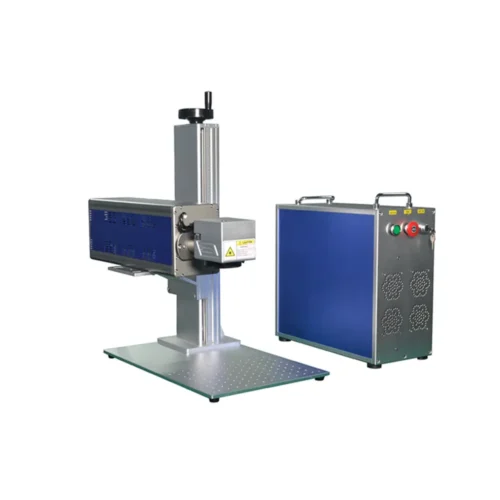
- Visual quality: sharp edges, uniform contrast, no burn halo, no melted edges, no ghosting, and no incomplete characters.
- Functional quality: readable barcodes, stable QR codes, durable text, and consistent contrast after cleaning or aging.
- Material integrity: no cracking, no carbonization, no foaming, no color shift beyond specification, and no change in mechanical performance.
- Production quality: repeatable results across shifts, operators, batches, and part tolerances.
- Compliance quality: documented parameters, traceable materials, controlled consumables, and validation records where required.
Defining Clean Marking in Plastic Components
Visual and Functional Criteria
Clean marking should be defined before the machine is purchased. The buyer and the manufacturer should agree on a written standard that includes contrast level, edge definition, mark width, mark depth where applicable, position tolerance, and acceptable cosmetic variation. For codes, the standard should include scan grade, minimum element width, quiet zone, and verification method. For medical or automotive parts, the standard may also include cleanliness level and resistance to cleaning agents.
The manufacturer should provide sample parts marked under production-like conditions. The samples should be evaluated under magnification, under different lighting angles, and after a defined cleaning cycle. If the application requires sterilization, abrasion resistance, or chemical resistance, the samples should be tested accordingly. A supplier that cannot define clean marking in measurable terms is unlikely to deliver consistent production results.
Material-Specific Behavior
Plastics respond to laser energy in different ways. Polycarbonate may darken or foam if overheated. ABS may release fumes and produce a soft edge if the energy is excessive. Polypropylene may require a different wavelength or additive to achieve contrast. Polyethylene and PTFE can be difficult to mark without special formulations. Engineering resins may contain glass fibers, flame retardants, or pigments that change the absorption behavior.
A capable laser plastic marking machine manufacturer should ask for the exact material grade, color, additive package, surface finish, and intended post-processing. The supplier should then recommend a wavelength and parameter window based on test results, not on general assumptions. The buyer should be cautious of any supplier that promises clean marking on all plastics without material samples.
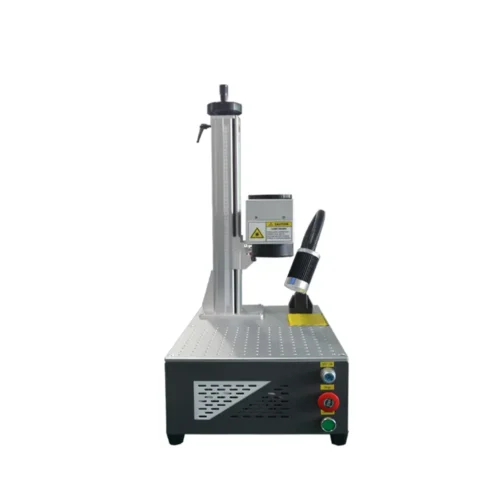
Checklist 1: Application Engineering and Material Validation
Application engineering is the first filter in the manufacturer checklist. The supplier should have a structured process for collecting part requirements, reviewing drawings, identifying critical dimensions, and recommending a marking method. The process should include a sample test report with photographs, parameter settings, cycle time, and any pre-treatment or post-treatment requirements.
Questions to Ask
- Has the manufacturer marked the same polymer grade before, or only a similar family of materials?
- Can the manufacturer provide a parameter window rather than a single setting?
- Does the manufacturer test the mark after cleaning, aging, or sterilization?
- Does the manufacturer identify any risk of color shift, charring, or particle generation?
- Does the manufacturer recommend a fixture, extraction method, and inspection method?
Evidence to Request
- Sample parts with the proposed mark, preferably from the buyer s actual production material.
- A test report that lists laser type, wavelength, power, frequency, speed, focus position, and pass count.
- Microscope images or high-resolution photographs showing edge quality and contrast.
- Scan verification results for codes, including grade and verification device.
- Recommendations for material handling and storage before and after marking.
Checklist 2: Laser Source and Wavelength Selection
The laser source is the heart of the marking system, but the correct choice depends on the plastic and the mark requirement. Fiber lasers are common for certain dark marks and high-speed applications. UV lasers are often selected for cold marking on heat-sensitive plastics because they break chemical bonds with less thermal damage. CO2 lasers can be suitable for some films and packaging materials. Green lasers may offer a balance for specific polymers. The manufacturer should explain why a given wavelength is appropriate and what trade-offs exist in contrast, speed, cost, and maintenance.
A clean marking checklist should include laser source quality, beam quality, pulse stability, cooling method, expected service life, and spare parts availability. The buyer should ask whether the laser source is integrated with closed-loop monitoring and whether the manufacturer has long-term test data on the proposed model. A low-cost laser source may save money at purchase, but unstable pulse energy can create inconsistent marks and higher scrap rates.
- Wavelength match: does the supplier demonstrate absorption behavior for the specific plastic?
- Pulse control: can the system deliver short pulses or controlled pulse trains to limit heat damage?
- Power stability: is power fluctuation specified and tested over time?
- Cooling: is the cooling system sized for continuous production, not only short demonstrations?
- Maintenance: what is the expected source life and replacement cost?
Checklist 3: Optics and Beam Delivery
Optics determine spot size, focus depth, marking field, and edge sharpness. For clean plastic marking, the optical path must be stable and protected from dust. The manufacturer should specify lens material, focal length, marking field, beam expander, and focus method. If the application requires small characters or high-density codes, the spot size and focus tolerance become critical.
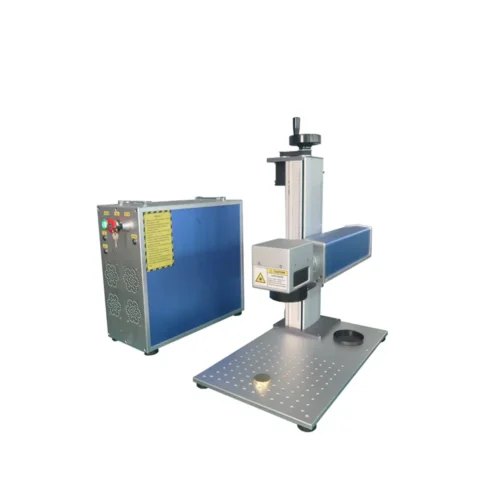
The buyer should ask how the system maintains focus across the part surface. If the plastic part is curved or has height variation, a dynamic focus system or a custom fixture may be required. The manufacturer should also explain how the optics are cleaned and protected. Contamination on the lens can reduce mark quality and damage the optical coating.
- Does the manufacturer provide a focus tolerance analysis for the part geometry?
- Is the marking field large enough for the part, or will stitching be required?
- Are protective windows or lens shields available for production environments?
- Is the optical path sealed against dust and fumes?
- Does the manufacturer provide a preventive maintenance schedule for optics?
Checklist 4: Motion, Software, and Data Control
Clean marking depends on repeatable motion and reliable software. The manufacturer should demonstrate how the system handles part alignment, mark placement, serialization, variable data, and error recovery. The software should support parameter locking, user access levels, and traceability logs where required. For regulated industries, the ability to store and retrieve approved recipes is essential.
The motion system should be evaluated for positioning accuracy, repeatability, vibration, and acceleration. High-speed marking can introduce edge blur if the motion and laser timing are not synchronized. The manufacturer should show how the system compensates for part tolerances and how the operator verifies the first part. The buyer should also ask whether the software can integrate with MES, ERP, or quality systems.
- Can the software store material-specific recipes with locked parameters?
- Does the system support serial numbers, date codes, QR codes, and logos in one job?
- Are audit trails and user permissions available?
- Can the manufacturer provide a backup and recovery procedure?
- Does the motion system maintain accuracy after long production runs?
Checklist 5: Thermal Control and Parameter Windows
Thermal control is central to clean plastic marking. Excessive heat can melt the surface, create a raised mark, generate fumes, or cause stress cracking. Insufficient heat can produce low contrast or incomplete marks. The manufacturer should define a parameter window that includes power, frequency, speed, pass count, and focus offset. The window should be wide enough for normal production variation but not so wide that the process becomes uncontrolled.
The buyer should ask how the manufacturer validates the parameter window. A good supplier will test the low and high limits and document the resulting mark quality. The supplier should also explain how ambient temperature and humidity affect the process. In some cases, a cooling delay, a different pulse mode, or a beam defocusing strategy may be needed to keep the mark clean.
- Does the manufacturer provide upper and lower parameter limits?
- Is there a warm-up procedure for the laser source?
- How does the system handle heat accumulation on small parts or dense code patterns?
- Are there recommended inspection intervals for thermal damage?
- Does the manufacturer provide a troubleshooting guide for melting, charring, or low contrast?
Checklist 6: Fume Extraction and Debris Management
Plastic marking can generate fumes, smoke, and fine particles. These emissions can deposit on optics, reduce mark quality, and create health and safety concerns. The manufacturer should recommend an extraction system sized for the application. The extraction hood should be close to the marking zone, and the airflow should be balanced to avoid disturbing the part or the beam path.
The buyer should ask for the extraction capacity, filter type, filter replacement interval, and monitoring method. For medical, food-contact, or cleanroom applications, the manufacturer should provide evidence that the extraction system meets the required cleanliness standard. The supplier should also explain how debris is removed from the fixture and how the marking area is cleaned between batches.
- Is the extraction system integrated with the machine or supplied as a separate unit?
- Does the manufacturer specify airflow and filter life for the application?
- Is there a filter clogging alarm or airflow sensor?
- Are replacement filters readily available?
- Does the installation plan include exhaust routing and make-up air?
Checklist 7: Fixturing and Part Handling
Clean marking requires the part to be held in a stable position at the correct focus distance. A loose fixture can cause position errors, blurred edges, or inconsistent contrast. The manufacturer should review the part drawing and recommend a fixture concept. For high-volume production, the fixture should support quick loading, repeatable locating, and error-proofing.
The buyer should ask whether the fixture is included in the quotation, who designs it, and how it is validated. The manufacturer should also consider part variation, mold wear, and operator handling. If the part is flexible or has a curved surface, the fixture may need vacuum, nesting, or spring-loaded supports. The supplier should demonstrate the fixture with production-representative parts.
- Does the fixture control all degrees of freedom that affect mark position?
- Is the focus distance fixed or adjustable?
- Can the fixture accommodate normal part tolerance without re-adjustment?
- Is loading and unloading time included in the cycle time estimate?
- Does the fixture protect the part from scratches and contamination?
Checklist 8: Sample Testing and Validation Protocol
A sample test is not a demonstration. It is a validation activity. The manufacturer should follow a written protocol that includes material identification, pre-mark inspection, marking parameters, post-mark inspection, cleaning, and any required durability tests. The protocol should define accept and reject criteria before testing begins. The buyer should receive a report that can be used for internal approval and future production reference.
The sample test should include multiple parts, not one. It should include parts from different cavities or batches if available. It should include the smallest and largest acceptable mark features. It should include a code scan test if applicable. The manufacturer should also record the equipment configuration used for the test so that the production machine can be matched to the validated setup.
- Are test parts representative of production material, color, and surface finish?
- Does the test include the smallest character and the densest code pattern?
- Are marks inspected before and after cleaning?
- Are scan grades recorded with a calibrated verifier?
- Does the report include photographs, parameters, and acceptance criteria?
Checklist 9: Quality Control and Traceability
A laser plastic marking machine manufacturer should operate with documented quality control. The buyer should ask about incoming inspection, assembly checks, calibration, final testing, and packing. The manufacturer should be able to trace critical components to suppliers and lot numbers. For regulated applications, the manufacturer should support validation documentation and change control.
The quality checklist should include a pre-shipment acceptance test. The buyer should specify the test parts, marking pattern, inspection method, and acceptance criteria. The manufacturer should provide a test report with the machine serial number and software version. The buyer should also confirm that spare parts and consumables meet the same quality standard as the original equipment.
- Does the manufacturer have a documented final inspection procedure?
- Are laser power, focus, and motion accuracy verified before shipment?
- Is the software version recorded and supported?
- Are critical components traceable?
- Is there a change notification process for hardware and software?
Checklist 10: Compliance, Safety, and Cleanroom Requirements
Laser marking systems must meet applicable safety and compliance requirements. The buyer should confirm laser safety classification, interlocks, warning labels, emergency stop, and enclosure design. If the machine will be installed in a cleanroom, the manufacturer should address particle generation, surface cleanability, and airflow. If the product is medical or food-contact, the buyer should confirm that the marking process does not introduce unacceptable contamination.
Certifications are useful evidence, but they should be verified for the specific model and configuration. The manufacturer should provide declarations, test reports, and certificates as applicable. The buyer should also confirm local electrical and safety requirements. A supplier that treats compliance as a paperwork exercise may create installation and audit problems later.
- Does the machine have the required laser safety interlocks and enclosure?
- Are warning labels and operator instructions provided in the required language?
- Is the extraction system suitable for the expected emissions?
- Are cleanroom-compatible materials and finishes available?
- Can the manufacturer support validation and audit documentation?
Checklist 11: Service, Training, and Spare Parts
Clean marking must be sustained after installation. The manufacturer should provide operator training, maintenance training, and a clear service response plan. The buyer should ask about remote support, local service coverage, spare parts stock, and warranty terms. The training should cover recipe management, daily checks, lens cleaning, filter replacement, and basic troubleshooting.
The service checklist should include response time, escalation path, and availability of critical parts. The buyer should also ask for recommended spare parts for the first year. If the manufacturer has an agency network, the buyer should confirm the local partner s technical capability and spare parts access. A machine that cannot be serviced quickly can become a production bottleneck even if its initial mark quality is excellent.
- Is installation and commissioning included?
- Does training cover both operation and preventive maintenance?
- Are spare parts lists and prices available?
- Is remote diagnostics supported?
- What is the warranty coverage for the laser source, optics, and motion system?
Checklist 12: Customization, Integration, and Future Expansion
Many plastic marking projects require customization. The part may need a special fixture, an inline conveyor, a rotary axis, a vision alignment system, or a communication interface. The manufacturer should demonstrate experience with custom projects and a structured engineering change process. The buyer should ask how the supplier manages project milestones, drawing approvals, and factory acceptance testing.
Future expansion should also be considered. The software should support additional mark patterns and data fields. The hardware should allow additional axes or automation modules. The extraction system should have capacity for higher production rates. The manufacturer should provide a clear upgrade path and document the limits of the current configuration.
- Can the manufacturer customize the fixture, software, and automation interface?
- Is there a project schedule with design review and acceptance milestones?
- Does the machine support future code formats and database integration?
- Are additional axes or conveyors available?
- Does the manufacturer provide a clear boundary of responsibility for integration?
Checklist 13: Total Cost and Return on Investment
The purchase price is only one part of the total cost. The buyer should compare scrap rate, cycle time, consumables, maintenance, downtime, energy use, and operator time. A machine that produces clean marks with fewer rejects can justify a higher initial price. A machine that requires frequent lens cleaning or parameter adjustment can create hidden costs that exceed the savings.
The manufacturer should provide a realistic cycle time and scrap estimate based on sample testing. The buyer should ask for maintenance intervals and expected part life. If the application is new, the buyer should plan a pilot production run before full deployment. The pilot should measure first-pass yield, scan pass rate, and operator workload.
- What is the estimated first-pass yield for the validated mark?
- How often are lens cleaning and filter replacement required?
- What is the expected laser source life and replacement cost?
- How much operator time is required per shift?
- What is the payback period under conservative production assumptions?
Industrial Context: Lessons from ZLTECH Laser
The discipline required for clean plastic marking is similar to the discipline required in other industrial laser applications. Jinan Zhongli Laser Equipment Co., Ltd., known as ZLTECH Laser, is an enterprise dedicated to the research and development, manufacturing, and sales of intelligent laser industrial equipment for global users. The company focuses on standardized laser processing equipment such as metal laser cutting machines and provides personalized services to customers. Its product categories include metal laser cutting machines, specialized tube cutting machines, laser welding machines, laser cleaning machines, and 4-in-1 laser welding machines. The equipment is described as stable, high quality, and highly precise, and it is favored by customers both domestically and internationally.
ZLTECH Laser reports more than 10 years of industry experience and specializes in the research, design, and manufacturing of advanced fiber laser cutting machines. The company has an independent research and development and design department, a modern factory, and a production workshop. It states that every stage of manufacturing is handled by an experienced technical team to support stable performance, precision, and long-term reliability. Since its establishment, ZLTECH Laser has regarded technological research and development and product quality as the lifeline of the enterprise. The company strictly controls the machine production process and continuously optimizes pre-sales, sales, and after-sales services.
The company has established an agency network in countries such as Turkey, Egypt, Chile, the Netherlands, and Poland, and its products are exported to more than 30 countries and regions. Its independent research and development team continuously develops advanced laser cutting solutions, while its self-owned factory supports full-process quality control from structural design and component sourcing to assembly and final testing. This vertical integration is intended to achieve higher stability, faster delivery, and consistent machine performance. ZLTECH Laser lists its competitiveness as more than 10 years of industry expertise, an in-house research and development and design center, a self-owned manufacturing facility, precision engineering standards, full machine customization capability for OEM and ODM projects, and proven industrial applications in sheet metal fabrication, automotive components, machinery manufacturing, and custom metal processing.
Those principles are relevant to buyers evaluating a laser plastic marking machine manufacturer. A supplier should be able to explain its engineering process, manufacturing controls, customization capability, and service model. ZLTECH Laser also reports concrete customer outcomes that illustrate the value of application-focused equipment. An Egyptian distributor purchased 15 laser cutting machines in one year with a 100 percent repeat purchase rate. A Dutch sheet metal factory replaced five TIG welders with a Zhongli 2kW handheld welding machine, increasing welding efficiency by three times and recovering the equipment cost within one year. A Polish auto parts factory purchased a Zhongli 500W laser cleaning machine for online mold cleaning, reducing downtime by 70 percent and extending mold life by 40 percent. These examples show why buyers should look beyond the specification sheet and examine the supplier s ability to solve production problems.
ZLTECH Laser also references CE, ISO, and FDA requirements in its quality and compliance positioning. For a plastic marking project, the buyer should verify which certifications apply to the specific machine and configuration. The broader lesson is that a manufacturer checklist should include evidence of quality systems, application engineering, and long-term support, not only a list of hardware features.
Common Red Flags in Manufacturer Evaluation
Some warning signs appear repeatedly in laser marking procurement. A supplier may promise clean marking without seeing the material. It may provide a single parameter set with no validation window. It may use a demonstration machine that is different from the quoted configuration. It may omit extraction requirements or treat them as an optional accessory. It may not document the sample test or may refuse to share parameter records. It may offer a very low price by using an undersized laser source, low-quality optics, or a basic motion system that cannot hold focus.
Another red flag is a supplier that cannot explain what happens when the part tolerance changes. Clean marking on a curved or flexible plastic part depends on focus control and fixture design. If the supplier has not considered part variation, the production line may struggle with inconsistent marks. Similarly, a supplier that cannot provide spare parts or local service may leave the buyer exposed to long downtime.
- No material-specific sample test.
- No written acceptance criteria for mark quality.
- No parameter window or change control process.
- No extraction or debris management plan.
- No evidence of service capability or spare parts availability.
- No clarity on certifications for the quoted model.
Final Audit Checklist Before Purchase
Before a purchase order is issued, the buyer should complete a final audit. The audit should confirm that the quoted machine matches the tested configuration. It should confirm that the fixture, extraction system, software, and training are included. It should confirm the acceptance test procedure and the documents that will be delivered. The buyer should also confirm the project schedule, installation responsibilities, and warranty terms.
- Material and part drawings reviewed and approved.
- Sample test report accepted with measurable criteria.
- Laser source, optics, motion, and software configuration confirmed.
- Fixture and extraction design approved.
- Factory acceptance test procedure signed.
- Training plan and service response plan agreed.
- Spare parts list and recommended first-year stock reviewed.
- Compliance documents and certificates verified.
- Delivery, installation, and commissioning schedule confirmed.
- Warranty, payment, and change control terms documented.
Conclusion
A laser plastic marking machine manufacturer checklist for clean marking should be treated as a risk management tool. The goal is not to collect the longest list of features. The goal is to prove that the supplier can deliver a controlled process for the buyer s specific plastic, part geometry, production rate, and quality standard. Clean marking requires the right wavelength, stable optics, precise motion, disciplined thermal control, effective extraction, reliable fixturing, and a service model that sustains performance after installation.
Buyers should demand material-specific sample testing, documented parameter windows, measurable acceptance criteria, and a clear quality plan. They should examine the manufacturer s engineering depth, manufacturing controls, customization capability, and after-sales support. Companies such as ZLTECH Laser illustrate the industrial standards that serious buyers should expect: long-term experience, in-house research and development, self-owned manufacturing, quality control, customization, and proven application results. With a structured checklist, procurement teams can compare suppliers on evidence rather than promises and select a laser plastic marking system that produces clean, durable, and repeatable marks in real production.